
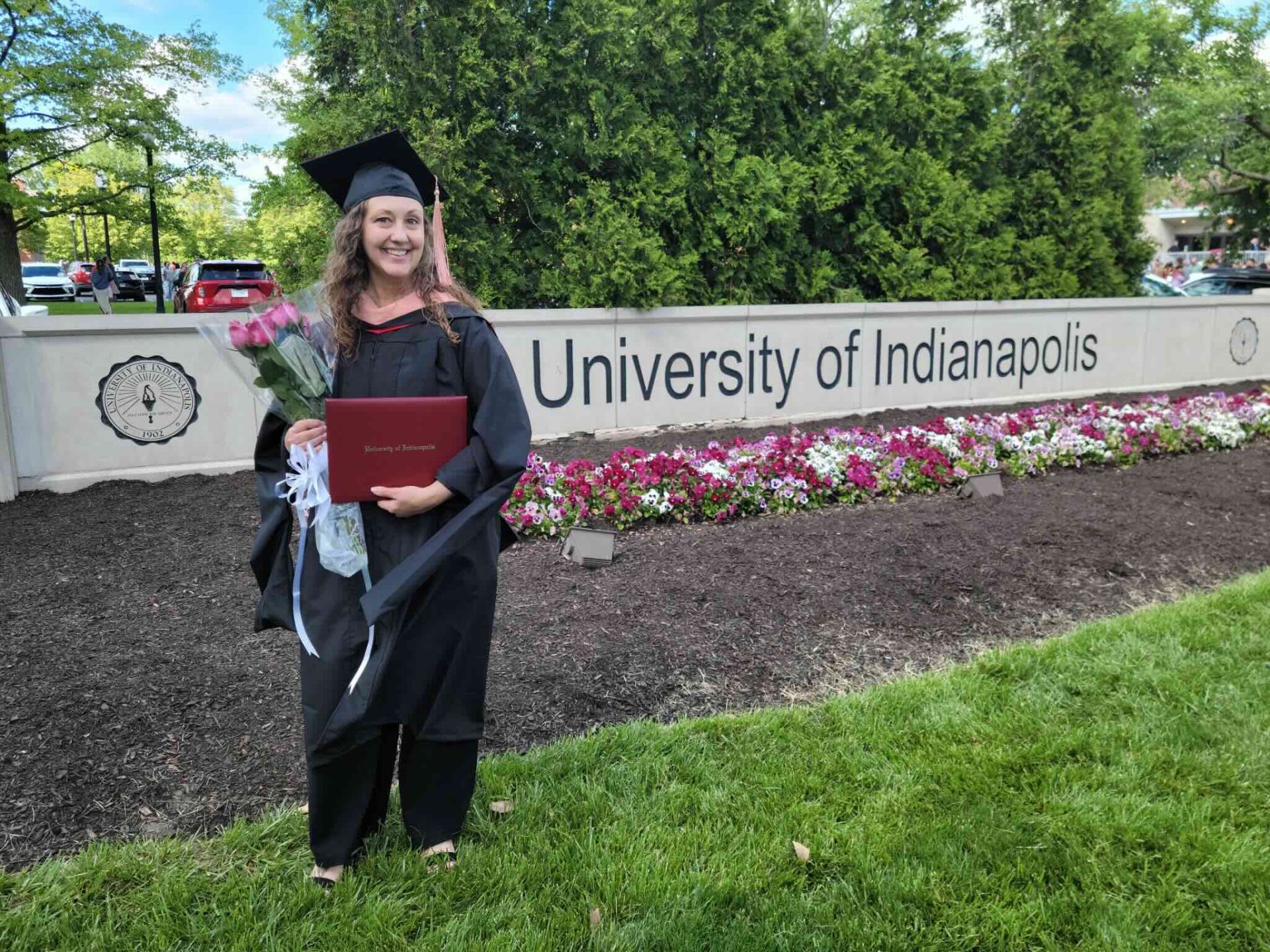
Casey Long ’21 ’26 (Liberal Arts, Master of Public Health) already had her dream job. As a living donor advocate with IU Health, she spent her days connecting with patients one-on-one and advocating for them as they navigated life’s most challenging moments by providing the information they needed to make informed decisions about organ donation and protecting their rights throughout the process.
But Long also knew she wanted to make a broader impact. To continue growing professionally and remain competitive in the healthcare field while remaining on the non-clinical side of the industry, she decided to pursue a Master of Public Health (MPH) degree.
As a single mother working full time, flexibility was essential. After earning her bachelor’s degree at the University of Indianapolis, Long knew UIndy’s fully online MPH program would provide the personalized support and schedule she needed.
“When I looked at UIndy, I knew that this was what I needed to keep me focused,” Long said. “I needed the smaller classrooms. I needed the individual attention, and that’s what attracted me.”
Long quickly connected with the MPH faculty. They were easy to talk to, responsive when Long had questions about her academic journey, and always eager to help connect her professional experience to her coursework.
“They were behind me 100% from start to finish,” Long recalled. “It was just an amazing experience. I just can’t say enough good things about UIndy.”
One of the required courses within the MPH program, MPH 535, tasks students with developing a program for a mock grant proposal. The course prepares students to develop public health programs from the ground up while learning how to secure the funding needed to bring those programs to life.
The project reflects the philosophy behind UIndy’s MPH program: students aren’t simply studying public health challenges—they’re developing solutions to them. Rather than relying on hypothetical scenarios, students are encouraged to draw from their own professional experiences and design programs that could be implemented in their communities or workplaces.
Long began the course expecting to focus on support programs for unhoused populations in Marion County, but midway through the semester, a work experience changed everything.
Long attended a town hall where Dr. Oluwafisayo O. Adebiyi, a nephrologist (kidney specialist) at IU Health, presented data on a troubling trend at outreach clinics in northern Indiana: Hispanic patients were receiving living donor kidney transplants at significantly lower rates than other patient populations. Dr. Adebiyi ended the presentation with a call for action, for someone to dig deeper into this trend and come up with a solution.
Long immediately felt a calling.
“This is it,” she remembered thinking. “This is what I want to do.”
Long emailed Dr. Carolyn Muegge, assistant professor of kinesiology, health and sport sciences, who taught MPH 535, to ask if it would be possible to change her project topic mid-semester. Dr. Muegge responded quickly with, “Yes, let’s talk it through.” Before the week was over, Long and Dr. Muegge connected and talked through how Long could approach this new topic.
“That’s the kind of individual attention you get at UIndy,” said Long.
Dr. Adebiyi’s presentation and Long’s own research revealed that many Hispanic patients simply lacked access to culturally and linguistically appropriate information about living kidney donation. So Long designed her program to equip Hispanic patients with the information needed to make an informed decision and combat any misconceptions about living kidney donation.
Her program would place outreach coordinators in dialysis centers and outreach clinics across northern Indiana, where they could meet patients face-to-face, provide educational materials in their preferred language, and answer questions with the help of interpreters or translation technology.
“We want patients to be educated about living kidney donation or, at least, provide the materials and let them make their own decision without showing any bias or negative assumption,” Long explained.
What began as a class assignment quickly evolved into something much bigger.
After sharing the project with her supervisor, Long was invited to present the initiative at IU Health’s upcoming Transplant Research for Enhancing Access Team (TREAT) Conference this fall, where the program will be introduced to colleagues across the organization. TREAT brings together a collaborative team of clinicians, biostatisticians, epidemiologists, behavioral scientists, and data scientists from the Regenstrief Institute, Indiana University, and Emory School of Medicine’s Department of Surgery to discuss how to improve access to each step of the transplant process.
“It was a little daunting at first because I thought, ‘I just did it for my degree,’ but then a part of me realized, ‘No, I did it because I am so passionate about this.’ And it helped me learn so much about our patients and helped me become a better advocate,” said Long.
“It allowed me to really use my degree, which is the whole reason I went back to school. I wanted to improve people’s lives and make the world a better place for everyone, and this is how I do it.”
At the annual Master of Public Health departmental awards celebration, Long told Dr. Kara Cecil, associate professor and director of undergraduate and graduate public health programs at UIndy, about the opportunity to present at TREAT and how she was a bit nervous. Dr. Cecil offered guidance on presenting her work and navigating the challenges ahead.
“She sat with me and talked through some things. I was telling her some of the barriers I was dealing with, and she offered suggestions, which was amazing. She didn’t have to do that. She could have just stopped it right then and there; the semester was over, and I graduated. And I thought, ‘This is why I chose UIndy.’”
Instead of remaining a classroom exercise, Long’s program may soon help shape how IU Health reaches Hispanic patients seeking information about living kidney donation—bringing Long one step closer to the reason she returned to graduate school in the first place: improving people’s lives.