
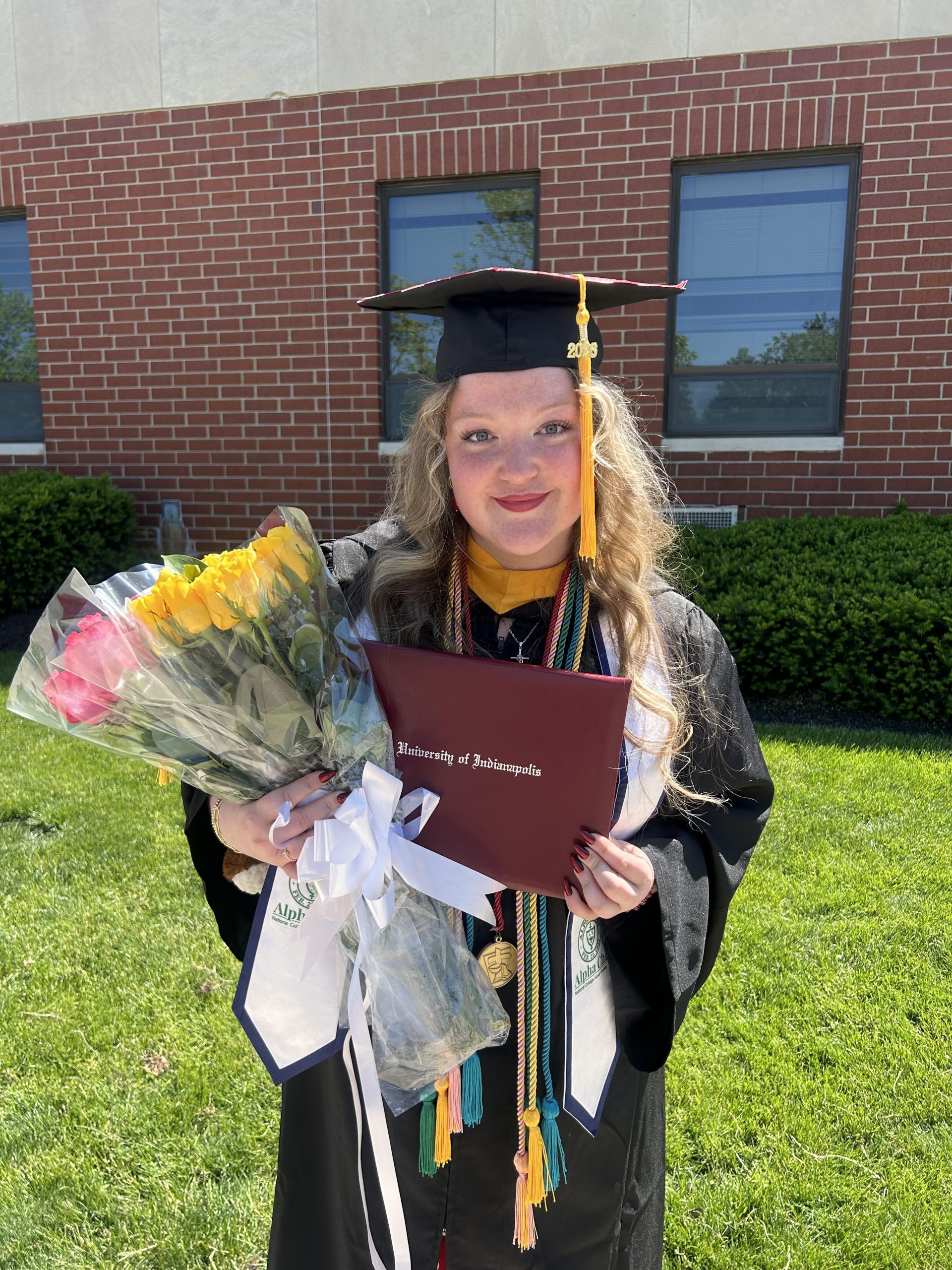
From a young age, Brenna Bastin ’26 ’29 (Public Health, Doctorate in Occupational Therapy) knew she wanted to help people struggling with their health. This passion influenced her decision to major in public health and then continue her studies to get a Doctorate in Occupational Therapy (OTD) at the University of Indianapolis.
“I tried to put my two loves together: public health, which comes from my love for helping those struggling with addiction, and occupational therapy, which comes from my love for helping people rehabilitate from debilitating injuries,” said Bastin.
While considering colleges, Bastin was attracted to UIndy’s highly ranked occupational therapy program, and visiting UIndy made her realize it was the school for her.
“As soon as I toured UIndy, I knew immediately I wanted to be here because of the location, the professors in the public health and occupational therapy programs, and small class sizes,” said Bastin.
Although the University’s public health department is small, Bastin is grateful she learned about its importance through her professors in the department.
“Public health was very niche when I started,” said Bastin. “There weren’t a lot of students in public health, and I felt like nobody knew what it was, but on this campus, having what you’re doing and its importance reinforced by professors helped me learn that just because people don’t know what public health is doesn’t mean it doesn’t change lives.”
Aside from academics, Bastin also joined many student organizations, including UIndy’s Eta Sigma Gamma chapter, the honor society for health education, the Student Government Association, and UIndy Chapel, where she currently serves as Worship Director. This position allowed Bastin to develop her leadership skills while strengthening her faith.
“I feel like I owe UIndy Chapel everything because it is the reason I found my calling,” said Bastin. “I was able to transition into the leadership role of being worship, and Reverend Arionne Lynch, who is the University Chaplain, has mentored me and taken me through so many experiences and retreats.”
The summer after her undergraduate commencement, Bastin worked as a cardiac screening intern at Franciscan Health Healthy Living and Screening Center. While interning, Bastin saw between twelve and fourteen patients a day, drew their blood for cholesterol prick tests, put the tests in a machine, and delivered and explained their results. Bastin felt this experience helped expand her medical knowledge and allowed her to see the importance of medical care providers.
“I felt like I had to learn a lot of medical terminology and extend my health literacy because these patients are counting on us to be able to give them their results,” said Bastin.
At UIndy, Bastin feels that her classes and professors helped prepare her for this internship, especially in terms of how to communicate with patients.
“I had a health coaching course taught by Dr. Mindy Mayol,” said Bastin. “She really set the tone for how we’re supposed to be talking to patients, how we’re supposed to be delivering educational resources, how we’re supposed to be engaging with them. I learned the importance of eye contact, leaning in, and responding in a timely manner, so the patients know that you’re listening to them and their concerns.”
Once she finishes her OTD, Bastin hopes to be an occupational therapist for patients who have experienced brain injuries. Becoming an occupational therapist with a major in public health is not common, but Bastin feels that her public health training brings a unique perspective to occupational therapy.
“I came into this occupational therapy program as a public health student, which is rare,” said Bastin. “A lot of undergraduates study exercise science and come more prepared for certain classes than others. However, my experience in public health has made me a lot more aware of all the applications of conditions that you treat as an occupational therapist, like external environments. I think what I learned in public health will really help me, especially with theories of health behavior and research. I felt like I was prepared in a very applied way.”
Bastin especially feels that her public health training has made her aware of the diversity of patients’ circumstances and inequality within the healthcare system.
“I feel very aware that not every patient is coming from the same academic background, the same neighborhood, the same economic status,” said Bastin. “I think public health really opened my eyes to all of the inequalities in health care, and if I wasn’t a public health major, I would be a lot more blindsided to the amount of inequality there is.”
Bastin hopes that future public health students at UIndy will remember how important educating people on public health is, even when they are new to the subject.
“Just because your friends and your family don’t know what public health is doesn’t mean you can’t pursue a career in it, learn about it, and apply it to those people’s lives,” said Bastin. “I think education of public health is the most important aspect of public health. It’s going to be the biggest tool that you learn from the program, and you’ll be able to implement and change the lives of people around you with that education.”